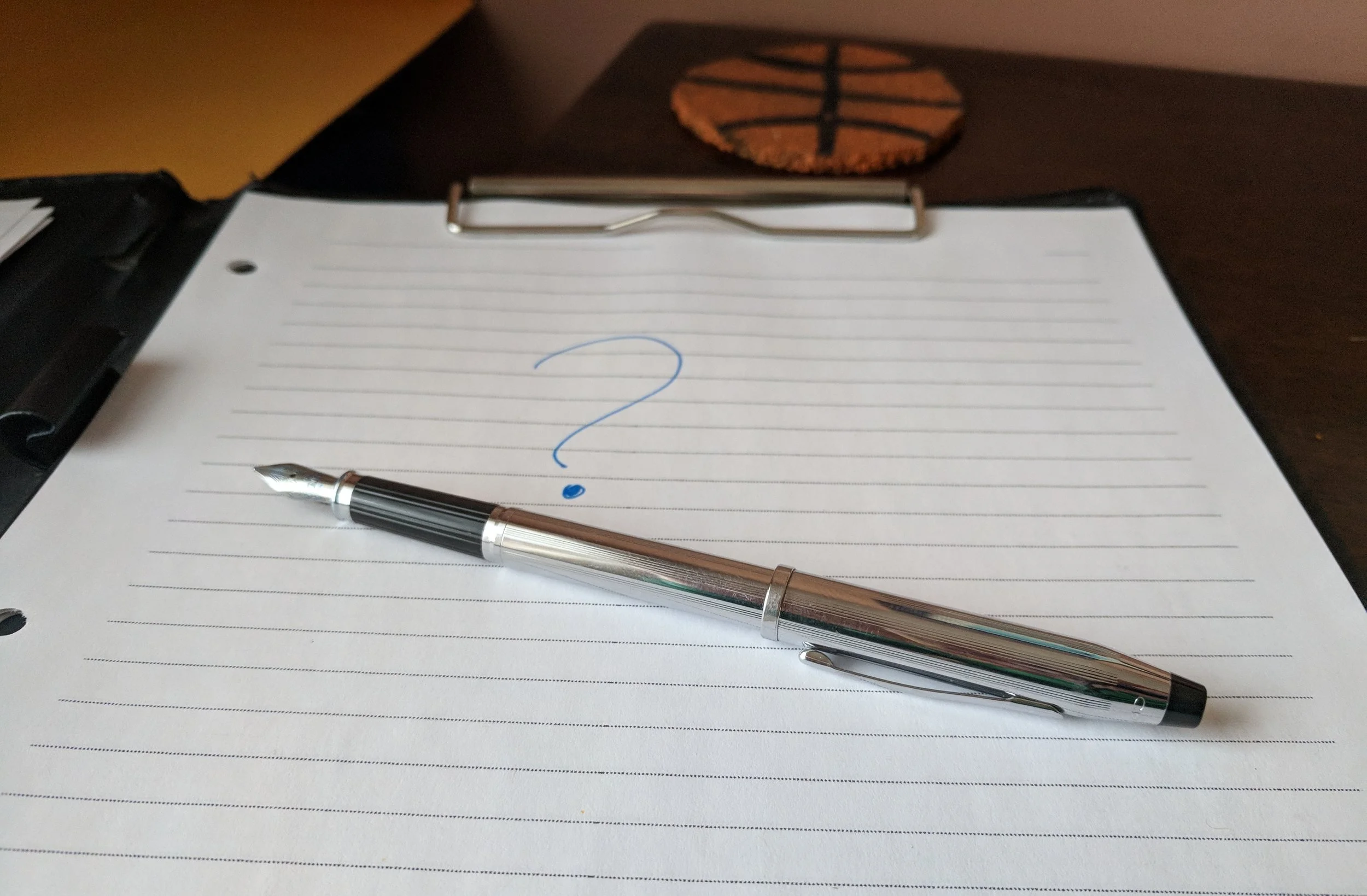
bgfay

still haven’t run out of ink

  • Home
  • About Me
  • Reading
  • Records
  • Blog Index
This is where the "magic" happens. 

This is where the "magic" happens. 

Magic In The Schools

February 28, 2018 by Brian Fay in Teaching

Yesterday, Jane, a colleague, worked with Frank from my class. He's odd. Jane says he's defiant. I think of him as mostly silent. Even when he speaks, which is rare, it's a mumble as if he wasn't spoken to as a baby, toddler, or even spoken now that he is in high school. He wears headphones constantly and often puts his head down on the desk refusing to engage. She sees defiance; I see habit and training. 

Frank was in my class, head down, and I asked him to go to the office if he needed to sleep. I said it gently, explaining I couldn't have him sleep in class. Mostly I wanted him to go see Jane. He didn't say much as he left, but there was body language: stiff back, sideways look, the way he pushed out of his chair. I was supposed to react, but I'm old enough to know there's no fight to win there.

Jane came in a bit later saying Frank was in her office. I nodded, happy he had gotten to the right place. She said, he's upset and doesn't like you. I don't blame him? Have you met me? I suggested I take a minute and talk with him. Jane thought it was too soon, he was too worked up. Okay, I said, wanting her to feel I trust her judgment. 

Jane apologized. I'm sorry, she said. For what? I asked. I'm working to stop her apologizing, but it's not going well. I'm sure she's sorry about that too. She said, I'm sorry I haven't fixed Frank. Fixed him? I asked. That's asking too much. He's in school and that's a start. Fixes, I told her, are a bad goal to shoot for. She apologized again. Sigh.  

Later she came back and I asked if I could tell Frank why I asked him to leave and show that it's not a disciplinary action. She agreed. I went in and sat in a chair lower than his so I wasn't threatening. I kept my voice light, matter-of-fact, explaining why I asked him to go and that I was happy he had come to the office. I told him, I can't make you do anything. What you do is your choice. 

I say this to a lot of students. It's simple honesty. I can't make them do anything, so I ask. I could threaten, but that doesn't work out well. It's always your choice, I told Frank. He nodded, surprised as every kid is when we talk about this. Honesty seems a crazy thing in school. I thanked him and went back to class. Frank was calm and nodded. 

It hasn't happened yet, but Jane will say I worked magic she doesn't understand. She often says this. I'll say, there is no magic. There's a theory and practice I've tested and modified for years. Frank was, according to Jane, defiant, so I chose to be absolutely pliant and give him nothing to defy. I was honest. I didn't want or demand anything from him. I gave. 

School admins and managers are big on outcomes. What's the result of this lesson, this talk, this whatever? I don't hold much with that. Learning is slow, non-linear. My intended outcome was to talk, listen, and demonstrate I'm no threat. I wanted Frank to feel some kindness and honesty. I didn't need anything from him. 

I'm no magician. I follow my theory where it leads because it has served me well. Science not magic. Jane doesn't have the same theory and expects other outcomes immediately. Because of her assumptions, I seem to do magic while she apologizes for getting bad results. 

I may have to find some magic to work on her. 

February 28, 2018 /Brian Fay
Pedagogy
Teaching
The best way to watch television news. And, hey, I'm on TV!

The best way to watch television news. And, hey, I'm on TV!

Tuning Out

February 26, 2018 by Brian Fay in Whatever Else

Yesterday I turned on the television and flipped through the channels. Infomercials, cable company complaining that a distributor raised rates, old reruns. I landed on CNN where the anchor was talking about arming teachers and outlining both sides of the argument. I groaned. Then a senator talked about how he's pleased to be invited to the White House to discuss gun policy after the Florida high school slaughter. I turned the television off wondering why I even try television news. 

The problems are these: 

  1. There aren't two sides to the idea of arming teachers
  2. Acting pleased to discuss problems with this administration is a lie or the height of foolishness. 

Arming teachers isn't serious policy. It is meant to distract. Arming teachers won't keep anyone safer and almost guarantees more bullets will fly. Think just a moment and apply logic to this. The next steps are to arm teachers with automatic weapons and to armor kindergartners in bulletproof vests. It's frighteningly laughable but the likely end of arming teachers. 

Arming teachers is aimed and loaded to protect gun manufacturers and the right to bear any arm anywhere. The other intent is to distract from the fact that being awash in guns, our nation is awash in our own blood. 

As for that senator's pleasure, he's going to an unhinged White House. It is the house of Twitter and when was the last reasoned and enlightening discussion on Twitter? It is no place for debate and neither is this White House. Twitter is dominated by name-calling and bullying. Note the Twitter feed of the White House's chief occupant. It is a sewer pipe. 

Which leads to why I've turned off television and radio news: they report government by tweet as something reasonable. I used to listen to NPR all the time, but they insist on covering his every tweet and boast. I've gone to print media where I can bypass tweet-talk and false equivalencies. Those really bother me. 

Listen for a moment. The Earth is not flat. There is no debate. Flat-Earth arguments are unworthy of equal time because they've been proven false. There are no two sides to the shape of the Earth. Such notions do not deserve equal time. 

Arming teachers is about as reasonable as believing in a flat Earth. 

The CNN anchor went out of his way to seem fair and balanced about arming teachers rather than calling out propaganda for what it is. That's not news or good journalism.

The Senator who acted as though he will be dealing with a fair-minded and reasonable group in the White House isn't being honest. What he thinks he's doing, I don't know.  

None of this is good for our nation. Ignoring facts, giving time to distractions, and respecting ideas that do not stand up to rigorous examination is likely to end in the deaths of more school children. 

I would like to hope for better from us. 

February 26, 2018 /Brian Fay
guns, White House, Twitter
Whatever Else
This book is almost too beautiful. 

This book is almost too beautiful. 

Happiness in 87 Words

February 26, 2018 by Brian Fay in Writing, Reading
“It is raining hard. The stereo is playing. I am alone. All the windows are shut, five o’clock in the evening. The rain is thundering, coming down hard. The stereo is up loud. I’m completely happy. It feels too easy: like walking in a dream. Surely I am missing something. It cannot be this easy. Happiness is supposed to be sought after, complex, to be found only with the greatest amount of cunning. 

Water roars off the roof, and I am dry. 

Later tonight I will fix coffee.”
— Rick Bass, Oil Notes, 107

This is a complete section of the book. Call it a chapter, a story or call it what you will, this is the thing complete, and I like it. I like the feel of it and the structure. Look closely. Listen. 

The first sentence is four words: one syllable, one syllable, two syllables, one syllable. So simple and clear, I hear the rain more than the sentence. Then another four-word sentence, this time with stereo's three syllables in the middle. Now I hear the music, but it's my music because I've already noticed the third sentence: "I am alone." I'm that I.

Bass, knowing he has pushed this simple sentence far enough, messes with it now. 

The next sentence isn't a proper sentence. It's more poetic than prose, the phrase after the comma left dangling. He repeats that in the next sentence with the rain, but the appended phrase functions more properly. From there he goes back to a simple sentence about the music turned up loud. This is warm up for the biggest thought of the day. Listen: 

I am completely happy. 

He is filled with happiness to the top of his being. It's as if he is happiness itself. It is a revelation.

He says, it feels too easy. His happiness is so large, he turns to simile, to the impossibility of dreaming, something we all know. 

When he begins the next sentence with "surely" I smile and almost laugh. Had he said that he was missing something, I wouldn't have believed. Had he asked, I wouldn't have wanted an answer. "Surely" says that he knows beyond being sure, that he's missing nothing, that he feels this thing absolutely. 

The next line, the longest of the whole piece, states what is the common thinking about happiness, the supposed to be, and puts the lie to all that. 

Not done, he hands out a statement that may or may not be a metaphor. The rain roars but he is dry. 

He finishes out of the blue: Later tonight, I will fix coffee. 

I want that coffee. And later today, I will fix some just to keep feeling this happy and to be complete. 

February 26, 2018 /Brian Fay
Happiness, Rick Bass
Writing, Reading
NothingToWrite.jpg

What To Do (when there's nothing to write)

February 23, 2018 by Brian Fay in Writing

There will be times when it seems there's nothing to write. I've felt that way for a week. I want to write, but nothing seems interesting enough. My plan is to post every day and work on longer projects in between, but I feel like I have nothing to say. What to do? 

My first inclination is to run away from the page and keyboard or to lose myself online. If I have nothing good to say, there's no point in writing. I want to sink into my bad mood and wait for something good to happen, but I know good things take forever to come. It's not that the world is such a bad place, quite the contrary. I've just learned that waiting is a good way to keep things from happening. That pisses me off, but it's true. 

I want to write this morning but feel I have nothing to say. I've done my Morning Pages, had coffee, taken fiber, shaved, and done twenty push-ups. I could throw in some laundry, clean my desk, or sit and type. The laundry and desk will wait while I type to change my luck. 

The oldest writing advice I know is to sit in the chair and do the work. Maybe I can open that advice up beyond just the directive. 

The reason I feel like I've nothing to say is that I don't believe my thoughts are worthy. That's mostly because I haven't thought things through. The thinking is all in my head, vague and wispy. Coming to the keyboard or the piece of paper forces me to elevate the thinking, organizing my thoughts into sentences, making paragraphs that work together. It's a kind of performance too. I'm explaining myself to an audience. As I type the first draft the audience is my skepticism. I wonder, _am I making sense? have I said this before?_ If I've said it before, I've left things unclear enough that I need a refresher. I'm not the only one in need of that refresher. I keep going. 

My butt is in the chair, but the magic is what I'm doing on the screen. I'm looking at the previous paragraph, going back to my initial thoughts, checking this sentence for sense, and hearing the next sentence coming. I can feel that I'm not done, that I haven't yet explained myself and am only partially moved by the words written so far. I have more I need to say.  

That ought to feel discouraging, but it's just the opposite. I know there's more to say not just because I remain unconvinced but because I have sentences still rolling down the conveyor belt of my mind waiting to be typed. Having written some of my thinking, I've opened the valve. More ideas are coming through that tap. 

The other thing I feel is that even when this thinking is done and I've finished the draft, there are other thoughts taking shape that I want to get down in letters and punctuation. The feeling of being stuck and unworthy is dissolving. The solvent was putting words on this page. 

None of this comes as much of a surprise. The solution to feeling unable to write is to sit and write. Of course. However, in the moment of being stuck, writing seems too uncomfortable to even begin. I can't imagine that anything good will come of it and want to run. What to do? 

Sit your butt in the chair and decide how many words to put on the screen, how many pages to fill, how long to keep writing. My plan today was for 500 words. Yesterday I set out to fill five notebook pages. Many times I set a timer for twenty minutes. A plan for quantity doesn't always result in quality, but it gets me writing and loosens up that feeling that I am terrible and unworthy. It's enough to stop me from running and start writing.

Sit in the chair. Take up the pen or open the laptop. Write and keep going. Tell the page or screen what you're thinking and make those thoughts convincing and clear to yourself. The writing won't be perfect; it doesn't need to be. You just need to keep writing. 

That's what to do. 

February 23, 2018 /Brian Fay
Writer's Block, Do The Work, Writing
Writing
  • Newer
  • Older

Subscribe to my weekly newsletter!