bgfay

still haven’t run out of ink

  • Home
  • About Me
  • Reading
  • Records
  • Blog Index
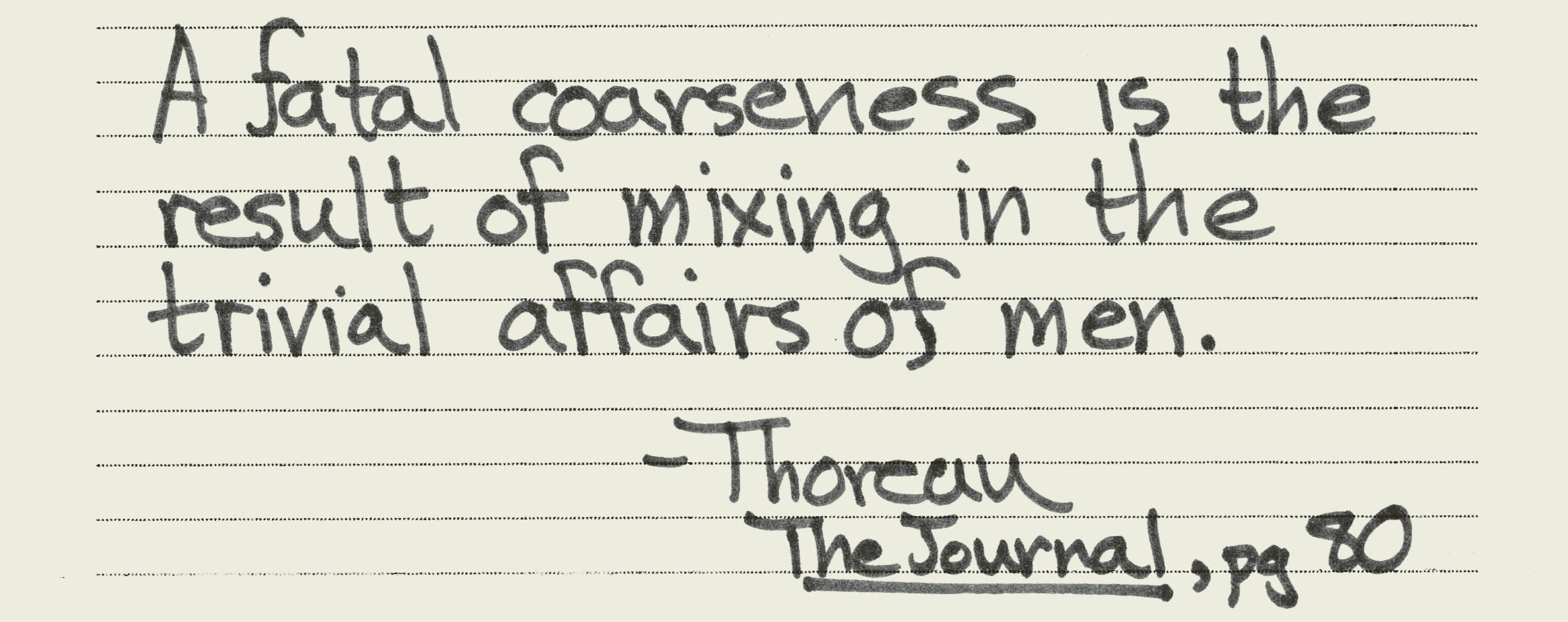
ThoreauQuote.jpg

The Right Direction

September 22, 2018 by Brian Fay in Whatever Else, Reading

On Friday, a kid left our school. The kid was a handful, often challenging, usually draining, really loud or completely withdrawn, a bundle of nerves. At the end of the day, after the kid had said a final goodbye, a few of us stood in the hall talking. It was mostly rehashing old complaints and expressing relief to be free of the kid. I stood thinking that this was the kind of kid for which our school is designed. As they talked I felt a courseness developing within me.

Thoreau wrote:

As I go through the fields, endeavoring to recover my tone and sanity and to perceive things truly and simply again, after...dealing with the most commonplace and worldly-minded men, and emphatically trivial things, I feel as if I had committed suicide in a sense." (The Journal, pg. 80)

I left the group and went into my classroom and be alone. I'm not sure I recovered my tone or sanity, but it was a step in the right direction.

I noticed again how often the right direction is away from the crowd and trivial affairs.

September 22, 2018 /Brian Fay
Thoreau
Whatever Else, Reading
Comment
Michiko Kakutani.jpg

Michiko Kakutani's The Death Of Truth

September 22, 2018 by Brian Fay in Reading

Overall, this was a pretty tough book. We elected something worse than a buffoon. We voted to dissolve most of what is good about our country. We didn't vote to make America great but to make America into something other than a democratic republic. We succumbed to trickery and a demagogue playing to our worst instincts and we are all suffering for it now.

Kakutani is a tremendous writer. Her prose is beautiful. This felt a bit too much like a book report or graduate thesis. I would have preferred to have just heard more from her, but it's still good to be aware.

Oh, one other thing: this confirms my decision to leave social media. That's a lot of what got us into all this trouble.

A few salient passages:

The tendency of Americans to focus, myopically, on their self-pursuits--sometimes to the neglect of their civic responsibilities--is not exactly new. In Democracy in America, written more than a century and a half before people started using Facebook and Instagram to post selfies and the internet was sorting us into silos of like-minded souls, Alexis de Tocqueville noted Americans' tendency to withdraw into "small private societies, united together by similitude of conditions, habits, and customs," in order "to indulge themselves in the enjoyments of private life." He worried that this self-absorption would diminish a sense of duty to the larger community, opening way for a kind of soft depostism on the part of the nation's rules--power that does not tyrannize, but "compresses, enervates, extinguishes, and stupefies a people" to the point where they are "reduced to nothing better than a flock of timid and industrious animals, of which the government is the shepherd." This was one possible cost of a materialistic society, he predicted, where people became so focused on procuring "the petty and paltry pleasures with which they glut their lives" that they neglect their responsibilities as citizens; it was difficult to conceive, he wrote, how such people who "have entirely given up the habit of self-government should succeed in making a proper choice of those by whom they are to be governed." (64-65, emphasis mine)

"With Google personalized for everyone," the internet activist Eli Pariser wrote in his book, The Filter Bubble, "the query 'stem cells' might produce diametrically opposed results for scientists who support stem cell research and activists who oppose it. 'Proof of climate change' might turn up different results for an environmental activist and an oil company executive. In polls, a huge majority of us assume search engines are unbiased. But that may be just because they're increasingly biased to share our own views. More and more, your computer monitor is a kind of one-way mirror, reflecting your own interests while algorithmic observers watch what you click." (116-117)

The nihilism in Washington is both an echo and a cause of more widespread feelings: a reflection of a growing loss of faith in institutions and a loss of respect for both the rule of law and everyday norms and traditions; a symptom of our loss of civility, our growing inability to have respectful debates with people who have opinions different from our own; and our growing unwillingness to give others the benefit of the doubt, room for an honest mistake, the courtesy of a hearing. (155)

September 22, 2018 /Brian Fay
Michiko Kakutani, Death of Truth, Reading
Reading
1 Comment
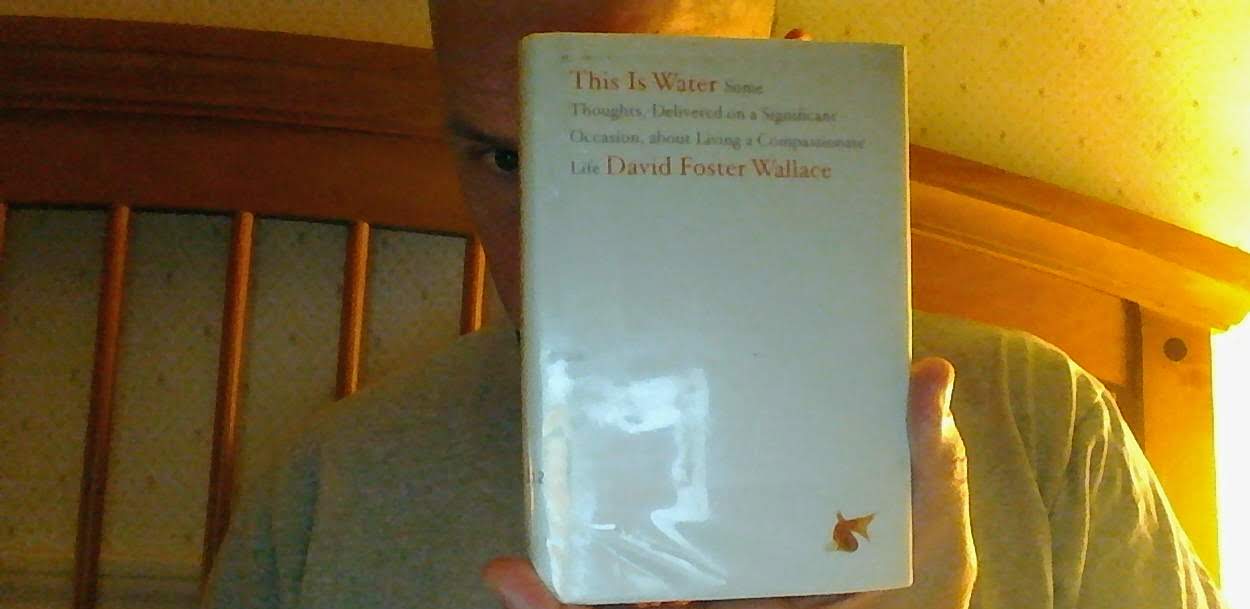
ThisIsWater.jpg

David Foster Wallace's This Is Water

September 18, 2018 by Brian Fay in Reading

This seems almost exactly right:

And I submit that this is what the real, no-shit value of your liberal arts education is supposed to be about: How to keep from going through your comfortable, prosperous, respectable adult life dead, unconscious, a slave to your head and to your natural default setting of being uniquely, completely, imperially alone, day in and day out. (60)

If you need something to read, I keep a list of every book I've read this year on my About Me page along with the albums I've purchased. And please, let me know what you think I should read next and why.

September 18, 2018 /Brian Fay
David Foster Wallace, Books, Essay
Reading
SedarisCalypso.jpg

David Sedaris's Calypso

September 18, 2018 by Brian Fay in Reading

My own father never listened to jazz, but I can just imagine him now, watching all of us in a room, laughing, talking, making food, and carrying on. He wouldn’t say it, but the way he looked at all of us, at all that was happening, I would know that it was all he wanted. Since he’s gone, I try to look around, listen, snap my fingers, and say, “isn’t this just fantastic?”

David Sedaris writes a lovely portrait here of his father.

The Sea Section (a vacation home) came completely furnished, and the first thing we did after getting the keys was to load up all the televisions and donate them to a thrift shop. It’s nice at night to work puzzles or play board games or just hang out, maybe listening to music. The only one this is difficult for is my father. Back in Raleigh, he has two or three TVs going at the same time, all turned to the same conservative cable station, filling his falling-down home with outrage. The one reprieve is his daily visit to the gym, where he takes part in a spinning class….

Being at the beach is a drag for our father. To his credit, though, he never complains about it, just as he never mentions the dozens of aches and pains a person his age must surely be burdened by. “I’m fine just hanging out,” he says. “Being together, that’s all I need.” He no longer swims or golfs or fishes off the pier. We banned his right-wing radio shows, so all that’s left is to shuffle from one side of the house to the other, sometimes barefoot and sometimes wearing leather slippers the color of a new baseball mitt. (88-89)

...I put on some music. “Attaboy,” my father said. “That’s just what we needed. Is this Hank Mobley?”

“It is,” I told him.

“I thought so. I used to have this on reel-to-reel tape.”

While I know I can’t control it, what I ultimately hope to recall about my late-in-life father is not his nagging or his toes but, rather, his fingers, and the way he snaps them when listening to jazz. he’s done it forever, signifying, much as a cat does by purring, that you may approach. That all is right with the world. “Man, oh man,” he’ll say in my memory, lifting his glass and taking us all in, “isn’t this just fantastic?” (92-93)

If you need something to read, I keep a list of every book I've read this year on my About Me page along with the albums I've purchased. And please, let me know what you think I should read next and why.

September 18, 2018 /Brian Fay
David Sedaris, Calypso, Books, Essays
Reading
  • Newer
  • Older

Subscribe to my weekly newsletter!